

Many people assume sitemaps only matter for large, complex websites, but even small sites benefit — especially when internal linking is weak or the site is new. Search engines rely on links to discover pages, and a poorly linked page can go uncrawled for weeks. A proper sitemap closes that gap by putting every important URL directly in front of search engines.
This guide won’t stop at just creating a sitemap — it’ll also cover how to structure it correctly, which pages to include (and exclude), how to connect it with robots.txt and Google Search Console, and advanced strategies for larger sites. Whether you’re building your first sitemap or refining an existing one, you’ll find practical, real-world guidance throughout.
Who Should Use Sitemap Generator UploadArticle.com?

This tool is built for anyone who wants their website pages to be discovered and indexed by search engines faster. Bloggers, small business owners, SEO professionals, ecommerce store owners, and developers managing multiple sites can all benefit. If you regularly publish new pages, run a large website, or struggle with pages not showing up in Google search results, a sitemap generator like this one removes the guesswork and technical hassle of creating and maintaining a proper XML sitemap.
What is Sitemap Generator UploadArticle.com?
Sitemap Generator UploadArticle.com is an online tool that automatically scans your website and creates an XML sitemap listing all your important URLs. Instead of manually coding a sitemap file, you simply enter your website address, let the tool crawl your pages, and download a ready-to-use sitemap file. It’s designed to make sitemap creation accessible even for people with no technical or coding background.
Key Features
Automatic website crawling and URL discovery, support for large websites with thousands of pages, options to exclude specific pages or folders, priority and change-frequency tagging, sitemap index file generation for very large sites, export in standard XML format compatible with Google and Bing, and a simple, no-code interface.
What is a Sitemap in SEO?
A sitemap is a file that lists the pages of a website in a structured format, helping search engines understand what content exists and how it’s organized. Think of it as a roadmap you hand to Google, telling it exactly which pages you want crawled and indexed, rather than leaving the search engine to discover them purely through links.
Do All Websites Need a Sitemap?
Not strictly, but almost every website benefits from having one. Very small websites with just a handful of well-linked pages may get indexed fine without a sitemap. However, larger sites, sites with weak internal linking, new websites, or sites with dynamic content (like ecommerce stores) benefit significantly, since a sitemap speeds up discovery and reduces the chance of pages being missed entirely.
Why Sitemap Generator UploadArticle.com is Important for SEO?
Search engines don’t automatically know every page on your site exists. A sitemap acts as a direct signal, helping search engines find new or updated content faster. Using a generator like UploadArticle.com removes manual errors, ensures the sitemap format meets search engine standards, and saves time that would otherwise go into coding or maintaining the file by hand.
How Sitemap Generator UploadArticle.com Improves Crawl Budget Efficiency?
Crawl budget refers to the number of pages a search engine bot will crawl on your site within a given time. A clean, accurate sitemap helps bots prioritize your most important pages instead of wasting time on duplicate, broken, or low-value URLs. By generating a sitemap that excludes irrelevant pages and highlights priority content, this tool helps search engines spend their crawl budget more efficiently.
What Data Does an XML Sitemap Include?
A typical XML sitemap includes the <loc> tag (the full URL of the page), <lastmod> (the date the page was last modified), <changefreq> (how often the page is expected to change), and <priority> (a relative value between 0.0 and 1.0). This structured data helps search engines understand not just which pages exist, but how important and how fresh each one is.
Should You Include Canonical URLs in Sitemap?
Yes. Only canonical (preferred) versions of a page should appear in your sitemap. Including non-canonical duplicate URLs can confuse search engines and dilute the SEO value of the canonical version. A good sitemap generator automatically filters out duplicates and keeps only the canonical URL for each piece of content.
Should Noindex Pages Be in Sitemap?
No. Pages marked with a “noindex” tag are telling search engines not to index them, so including them in a sitemap sends a contradictory signal. It’s considered best practice to exclude noindex pages, thank-you pages, admin pages, and duplicate content from your sitemap entirely.
HTTP vs Non HTTPS in Sitemap

Your sitemap should only list URLs using the secure HTTPS protocol if your site has HTTPS enabled. Mixing HTTP and HTTPS URLs in the same sitemap can cause indexing inconsistencies and duplicate content issues. Always double-check that your sitemap generator pulls URLs from the live, secure version of your site.
Sitemap Limits You Must Know
Google and most search engines enforce a maximum of 50,000 URLs per sitemap file and a maximum uncompressed file size of 50MB. If your site exceeds these limits, you’ll need multiple sitemap files combined under a sitemap index file, which tools like UploadArticle.com can generate automatically for larger websites.
How to Use Lastmod Tag Effectively?
The <lastmod> tag tells search engines when a page was last updated. To use it effectively, only update this timestamp when meaningful content changes occur — not for minor edits like fixing a typo. Accurate lastmod dates build trust with search engines and can encourage more frequent recrawling of genuinely updated pages.
What is a Sitemap Index File?
A sitemap index file is essentially a “sitemap of sitemaps.” When a website has more URLs than a single sitemap file can hold, multiple sitemap files are created, and the index file lists and links to each of them, giving search engines one central file to reference.
Example
xml
<sitemapindex xmlns=”http://www.sitemaps.org/schemas/sitemap/0.9″>
<sitemap><loc>https://example.com/sitemap1.xml</loc></sitemap>
<sitemap><loc>https://example.com/sitemap2.xml</loc></sitemap>
</sitemapindex>
Where Should You Place Your Sitemap?
The sitemap file should typically be placed in your website’s root directory, such as https://example.com/sitemap.xml. This location makes it easy for search engines to find and is the standard convention referenced by robots.txt files and search console submissions.
How to Add Sitemap in Robots.txt?

Adding your sitemap to robots.txt helps search engines discover it automatically. Simply add this line: Sitemap: https://example.com/sitemap.xml. This can be placed anywhere in the file and doesn’t interfere with your other crawl directives.
Example of XML Sitemap
xml
<?xml version=”1.0″ encoding=”UTF-8″?>
<urlset xmlns=”http://www.sitemaps.org/schemas/sitemap/0.9″>
<url>
<loc>https://example.com/</loc>
<lastmod>2026-01-15</lastmod>
<changefreq>weekly</changefreq>
<priority>1.0</priority>
</url>
</urlset>
Types of Sitemaps
| Sitemap Type | Purpose | Best For |
| XML Sitemap | Standard format read by search engine crawlers | All websites, especially for general page discovery |
| HTML Sitemap | User-facing page listing internal links | Visitors who want to navigate the site manually |
| Image Sitemap | Helps search engines discover and index images | Photography sites, ecommerce, image-heavy blogs |
| Video Sitemap | Helps search engines discover and index video content | Video platforms, tutorial sites, media publishers |
| News Sitemap | Highlights fresh, time-sensitive content | Sites approved for Google News |
Role of Sitemap in Mobile-First Indexing
Since Google primarily uses the mobile version of a site for indexing and ranking, your sitemap should reflect the URLs and content structure of your mobile site. If your mobile and desktop versions differ significantly, an accurate, up-to-date sitemap ensures the correct mobile-friendly pages are prioritized for crawling.
Advanced SEO Strategies Using Sitemap Generator
| Strategy | What It Involves | SEO Benefit |
| Segment Sitemaps by Content Type | Create separate sitemaps for blog posts, products, and categories | Easier for search engines to crawl and prioritize each content type |
| Assign Strategic Priority Values | Give higher priority tags to cornerstone/high-value pages | Signals which pages matter most for crawling focus |
| Refresh Lastmod on Key Pages | Update the lastmod date when high-value content is meaningfully revised | Encourages more frequent recrawling of important pages |
| Exclude Low-Value URLs | Remove thin, duplicate, or outdated pages from the sitemap | Keeps crawl budget focused on quality content |
| Use Sitemap Index for Scaling | Combine multiple sitemaps under one index file as the site grows | Keeps large sites organized and within sitemap size limits |
Dynamic vs Static Sitemap
| Static Sitemap | Dynamic Sitemap | |
| Manually created and edited | Automatically updates as site content changes | |
| Small, rarely-changing websites | Blogs, ecommerce, news sites with frequent updates | |
| High — requires manual regeneration | Low — no manual work needed | |
| High, since new/removed pages aren’t reflected automatically | Low, since it stays in sync with live content | |
| Simple to create once | Usually needs a tool or plugin to automate | |
| A small business site with a fixed set of pages | A store adding new products or a blog publishing regularly |
Sitemap and Topical Authority
While a sitemap itself doesn’t directly build topical authority, it helps search engines discover and crawl all your related content faster, which allows your internal linking and content clusters to be recognized sooner. Well-organized sitemaps indirectly support the process of establishing your site as an authority on a subject.
Advanced Optimization Tip: Sitemap Quality Matters More Than Quantity
Stuffing a sitemap with every URL your site has ever generated — including thin, outdated, or low-value pages — can actually hurt your SEO signals. A smaller sitemap filled only with genuinely valuable, indexable pages sends a stronger quality signal than a bloated one filled with junk URLs.
Why Your Pages Are Not Indexed?
Common reasons include: the page isn’t in the sitemap, it has a noindex tag, it’s blocked by robots.txt, it has thin or duplicate content, it has weak backlinks or no internal links pointing to it, or crawl budget is being wasted elsewhere on the site.
How Long Does Indexing Take with Sitemap?
Indexing time varies. With a submitted sitemap, new pages are sometimes indexed within a few hours to a few days, though for lesser-known or newer domains it can take one to several weeks. Submitting your sitemap through Google Search Console generally speeds up this process compared to waiting for organic discovery.
Common Sitemap Errors
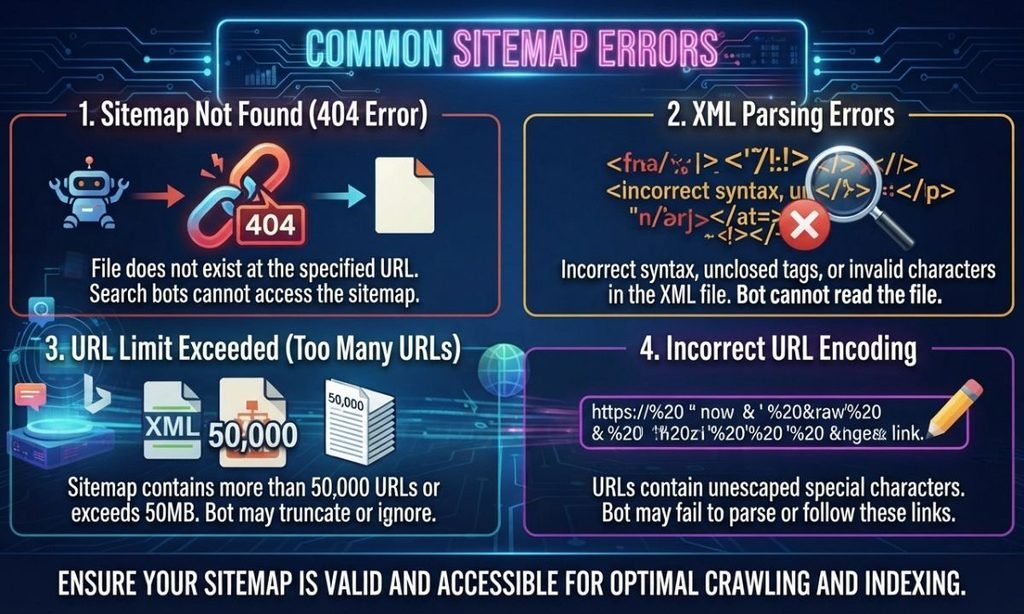
| Common Error | Why It’s a Problem |
| Including broken (404) URLs | Wastes crawl budget and signals poor sitemap maintenance |
| Listing pages blocked by robots.txt | Sends conflicting signals — sitemap says “crawl this,” robots.txt says “don’t” |
| Mixing HTTP and HTTPS URLs | Can cause duplicate content and indexing inconsistencies |
| Exceeding the 50,000 URL or 50MB limit | Sitemap may be rejected or only partially processed by search engines |
| Incorrect XML formatting | Can cause the entire sitemap to fail validation or not be read at all |
| Outdated lastmod dates | Misleads search engines about which pages actually need recrawling |
Manual vs Auto Sitemap
Manually built sitemaps require ongoing maintenance and are prone to human error, especially on larger sites. Auto-generated sitemaps, like those created by UploadArticle.com, update automatically as your site changes, reducing errors and saving significant time — a major advantage for sites that publish or update content frequently.
Sitemap Generator UploadArticle.com vs Other Tools
Compared to many generic sitemap tools, UploadArticle.com focuses on simplicity and accuracy — offering automatic crawling, sitemap index support for large sites, and clean XML output without requiring plugins or technical setup. This makes it a practical choice for users who want a fast, no-code solution rather than a complex enterprise tool.
How Sitemap Supports E-E-A-T?
E-E-A-T (Experience, Expertise, Authoritativeness, Trustworthiness) is about content quality, but a sitemap plays a supporting role by ensuring your best, most authoritative content is discovered and indexed promptly. When your expert content isn’t buried or missed by crawlers, it has a better chance to demonstrate E-E-A-T signals to search engines.
Real SEO Case Study
A mid-sized ecommerce site with over 10,000 product pages struggled with inconsistent indexing — many new products weren’t appearing in search results for weeks. After generating a clean, segmented sitemap (separating products, categories, and blog content) and submitting it through Search Console, the site saw significantly faster indexing of new product pages within days instead of weeks, along with a noticeable increase in organic impressions over the following months.
Common Mistakes
Forgetting to update the sitemap after a redesign, including redirected or deleted URLs, not submitting the sitemap to Search Console, ignoring sitemap errors reported by Google, and treating the sitemap as a ranking factor rather than a discovery tool.
Sitemap vs Robots.txt
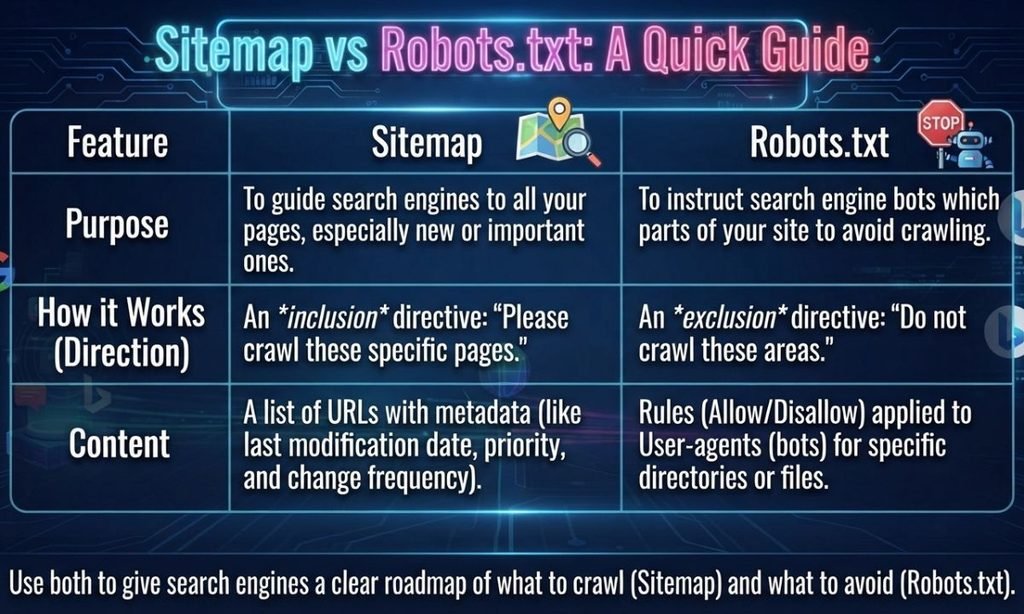
AspectSitemapRobots.txtPurposeTells search engines which pages you want indexedTells search engines which pages/folders you don’t want crawledFunctionInvites and guides crawlingRestricts and blocks crawlingDirectionPositive signal (crawl these)Negative signal (avoid these)File FormatXML filePlain text fileLocationUsually at /sitemap.xmlUsually at /robots.txtRelationshipComplementary — both should align consistentlyComplementary — misconfiguration causes mixed signals
Does Sitemap Guarantee Rankings?
No. A sitemap only helps with discovery and crawling — it has no direct influence on where a page ranks. Rankings depend on content quality, relevance, backlinks, user experience, and many other factors. A sitemap simply ensures your pages have the opportunity to be indexed and considered in the first place.
Does Sitemap Affect CTR?
Not directly. Click-through rate depends on your page’s title, meta description, and how it appears in search results — not on the sitemap itself. However, by helping pages get indexed sooner, a sitemap indirectly gives your content the chance to start earning clicks and impressions earlier.
Pro Insight: Sitemap is a Discovery Tool, Not a Ranking Factor
It’s worth repeating: a sitemap’s job is to help search engines find your pages, not to boost their rankings. Treat it as part of your technical SEO foundation, not a shortcut to higher positions in search results.
Pro Tips
Keep your sitemap updated automatically rather than manually, exclude noindex and duplicate pages, submit through Google Search Console and Bing Webmaster Tools, use separate sitemaps for large sites, and regularly check for crawl errors.
Future of Sitemap SEO (2026)
As websites grow more dynamic and AI-driven search experiences expand, sitemaps are likely to play an even bigger role in helping search engines and AI crawlers quickly understand site structure. Expect increased emphasis on structured, segmented sitemaps and closer integration between sitemap data and content freshness signals.
Sitemap Optimization Checklist
Sitemap includes only canonical, indexable URLs; no noindex or blocked pages included; HTTPS used consistently; under 50,000 URLs and 50MB per file; sitemap index used for larger sites; sitemap referenced in robots.txt; submitted to Google Search Console; lastmod dates accurate and current.
Related SEO Keywords for Better Optimization
Sitemap generator, XML sitemap, sitemap submission, Google Search Console sitemap, crawl budget optimization, website indexing, technical SEO, robots.txt, sitemap index file, mobile-first indexing.
How to Submit a Sitemap to Google Search Console?
Log in to Google Search Console, select your verified website property, navigate to the “Sitemaps” section in the left menu, enter your sitemap URL (e.g., sitemap.xml), click “Submit,” and monitor the status for successful processing or errors.
Best Practices for Naming and Structuring Sitemap Files
Use clear, descriptive file names like sitemap.xml, sitemap-posts.xml, or sitemap-products.xml rather than vague or randomly generated names. For larger sites, structure sitemaps by content type and connect them through a single sitemap index file for easier management and troubleshooting.
Troubleshooting: Sitemap Submitted But Not Fetched
If Google Search Console shows your sitemap as “submitted” but not “fetched,” check for an incorrect sitemap URL, a sitemap blocked by robots.txt, server errors preventing access, invalid XML formatting, or recent site downtime during the crawl attempt. Fixing the underlying issue and resubmitting usually resolves it within a few days.
Sitemap Generator UploadArticle.com: Step-by-Step Setup Guide
Visit Sitemap Generator UploadArticle.com, enter your website’s URL, let the tool crawl and scan your pages, review and exclude unwanted URLs, generate the XML sitemap file, download and upload it to your root directory, add it to robots.txt, and submit the sitemap URL to Google Search Console.
How Often Should You Update Your Sitemap?
For frequently updated sites like blogs or ecommerce stores, sitemaps should update automatically with every new page or product. For smaller, static websites, reviewing and regenerating the sitemap every few months — or whenever major content changes happen — is generally sufficient.
Sitemap for Large vs Small Websites: What Changes?
Small websites with a few dozen pages can often rely on a single, simple sitemap and may even get indexed fine without one. Large websites with thousands of pages need segmented sitemaps, a sitemap index file, careful prioritization of important pages, and more frequent automated updates to keep pace with content changes and avoid exceeding sitemap size limits.
Also read/wym-meaning-in-text-complete-guide-to-wym/
Conclusion
A well-structured sitemap remains one of the simplest yet most effective technical SEO tools available in 2026. Sitemap Generator UploadArticle.com makes the process accessible by automatically crawling your site and producing a clean, accurate XML sitemap without requiring coding knowledge. While a sitemap won’t directly boost your rankings, it plays a crucial supporting role — helping search engines discover, crawl, and index your content faster and more efficiently. Combined with clean site structure, proper robots.txt configuration, and regular submission through Search Console, a solid sitemap strategy gives every page on your site a fair chance to be found.
Frequently Asked Questions
Do I need to update my sitemap manually?
Not if you use an auto-generating tool — it updates automatically as your site changes.
Can a sitemap hurt my SEO?
A sitemap itself won’t hurt your SEO, but including broken links, noindex pages, or duplicate URLs can send confusing signals to search engines.
Is XML sitemap better than HTML sitemap?
They serve different purposes — XML sitemaps are built for search engines, while HTML sitemaps help human visitors navigate your site. Most websites benefit from having both.
Does every page need to be in the sitemap?
No — only canonical, indexable, high-value pages should be included.
How do I know if my sitemap is working?
Check Google Search Console’s Sitemaps report for successful processing, and the Coverage report to see how many submitted URLs are actually indexed.